
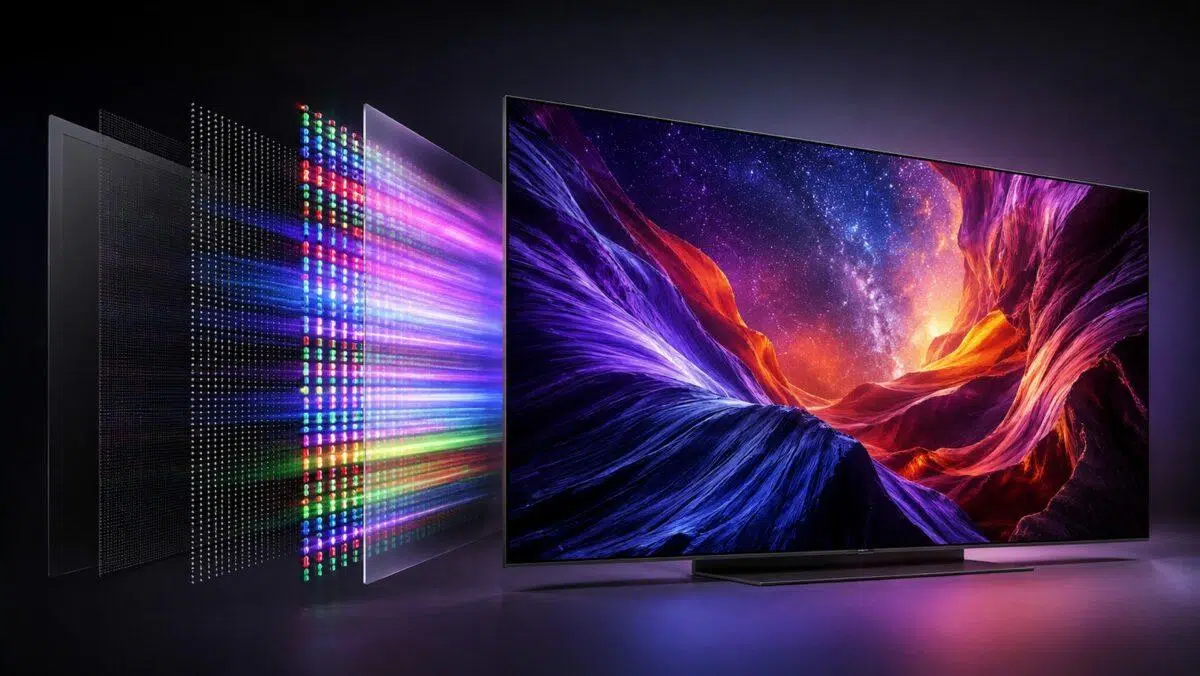
The display industry is about to take a major leap forward. LG Display has officially unveiled FLiPP , a new OLED panel manufacturing method that promises to be a game-changer. The technology, whose name stands for FMM—Innovative Pixel Patterning—completely eliminates the thin metallic mask that has been used for over a decade to deposit the organic materials in the pixels. Instead, it employs a photolithography process using ultraviolet light, allowing for much more precise pixel drawing.
The announcement was made at the International Meeting on Information Display (IMID) 2026 , held in Busan, South Korea, where the South Korean company showcased the advancements of this technology, which it had been secretly developing for months. According to data provided by the company, panels manufactured with FLiPP offer substantial improvements in brightness, efficiency, and durability, which could represent a turning point for the television and mobile device industry.

What is FLiPP and how does it work?
To understand the magnitude of this advancement, it's helpful to recall how OLED panels are currently manufactured. The traditional method, known as FMM (Fine Metal Mask), works similarly to a stencil: red, green, and blue organic materials are evaporated through tiny holes drilled into metal plates. The problem is that these masks, as they increase in size, tend to warp under their own weight , causing misalignments and, sometimes, color mixing defects. Furthermore, each change in resolution or screen size requires the manufacture of new masks, a costly and time-consuming process.
FLiPP takes a radical turn in this approach. Instead of using metal masks, the technology sequentially coats RGB pixels, fixes them in precise positions, and uses ultraviolet photolithography to eliminate unnecessary areas during patterning. In other words, the pixels are drawn using light rather than physical templates , a similar approach to that used in semiconductor manufacturing. This change allows for an increase in the subpixel aperture ratio of approximately 55%, resulting in a much larger light-emitting surface.

Improvements in brightness, lifespan and energy consumption
The advantages of FLiPP extend beyond theory. According to data provided by LG Display, panels manufactured with this technology offer peak brightness levels 60% higher compared to those produced using FMM under identical conditions. This improvement is due to the fact that, by eliminating the physical space occupied by the mask structure, the subpixel aperture ratio increases significantly, allowing a larger surface area to emit light without stressing the electronics.

But brightness isn't the only improvement. The company has also announced that the lifespan of the panels increases 2,4 times if current luminance levels are maintained, as the reduced stress on the organic compounds drastically slows their degradation. Furthermore, power consumption is reduced by 13%, a particularly relevant figure at a time when energy efficiency regulations are becoming increasingly stringent. All of this, according to the company, is achieved without sacrificing the dynamic impact of HDR.
Another major advantage of FLiPP is that it allows for up to 64% greater utilization of the master glass . Thanks to its existing production infrastructure for large-format Tandem WOLED panels, LG Display has become the first company to manufacture FMM-free OLED panels using 8,5G master glass as a single piece, without the need to divide it into smaller substrates. This results in less material waste and, therefore, reduced manufacturing costs.
Million-dollar investment and production plans
The FLiPP announcement is more than just a technological demonstration. According to industry sources, LG Display plans to invest around 3 trillion won (approximately €2.000 billion) to launch commercial production of this technology. The P10 plant in Paju, Gyeonggi Province, is the leading candidate to house the new manufacturing line, which will feature equipment for deposition, exposure, etching, and handling of large-format substrates.

The company plans to finalize equipment specifications and investment plans with its suppliers at an internal meeting in September, with purchase orders expected to be placed in January of next year. The first FLiPP panels are projected to reach the market in the third quarter of 2027 , according to analyst estimates. The technology will initially be applied to IT products, such as tablets and monitors, before expanding to a broader range, from one-inch wearables to large-format televisions.

No limits on size or panel type
One of FLiPP's most striking features is that it isn't subject to the size and resolution restrictions that limit the FMM method . In theory, the technology could be used to manufacture displays ranging from 1 to 100 inches, both in conventional panels and in displays for virtual and augmented reality devices. This opens the door to specifications that until now clashed with the physical limitations of the traditional process, such as very small formats with high pixel densities or large-area foldable displays like those from LG .
The South Korean company has already filed trademark applications for FLiPP in both Korea and several key international markets, a move aimed at protecting its proprietary technology from potential competitors. Indeed, it is the only FMM-free manufacturing process for 8,5G generation OLED panels , giving it a significant competitive advantage in an increasingly contested market.

The manufacturing process, however, is not without its challenges. The deposition of organic materials and photolithography must be repeated for each RGB color, adding exposure, development, and etching steps. The main technical challenges involve minimizing damage to the organic emissive layers during exposure to ultraviolet light and maintaining uniform patterns on large substrates. To address this, LG Display is working with suppliers like YAS, which is developing 8,5G generation equipment capable of depositing organic materials uniformly without the need for a mask.
Recognition of HDS technology
In addition to FLiPP, LG Display took advantage of IMID 2026 to highlight another of its technological advancements. Hyper Double Scanning (HDS) technology, which doubles the data transfer speed in the control electronics of OLED panels , received the "Display of the Year" award in the technological excellence category. This system, already being implemented in the production of the company's OLED TV panels, allows the native refresh rate of the panels to be scaled from the current 144 Hz to 165 Hz, an improvement that will be especially useful for video game enthusiasts and sports fans.
The combination of FLiPP and HDS positions LG Display to lead the high-end display market in the coming years. The company, already the world's leading manufacturer of OLED panels for televisions, is confident that this new technology will allow it to maintain its competitive edge over rivals such as Samsung Display and Japan's JDI, which is also developing a similar process known as eLEAP.
